Openers · Newmarket
Garage Door Remote and Keypad Programming in Newmarket
The opener is an older one with a row of tiny switches inside the remote.
In plain words
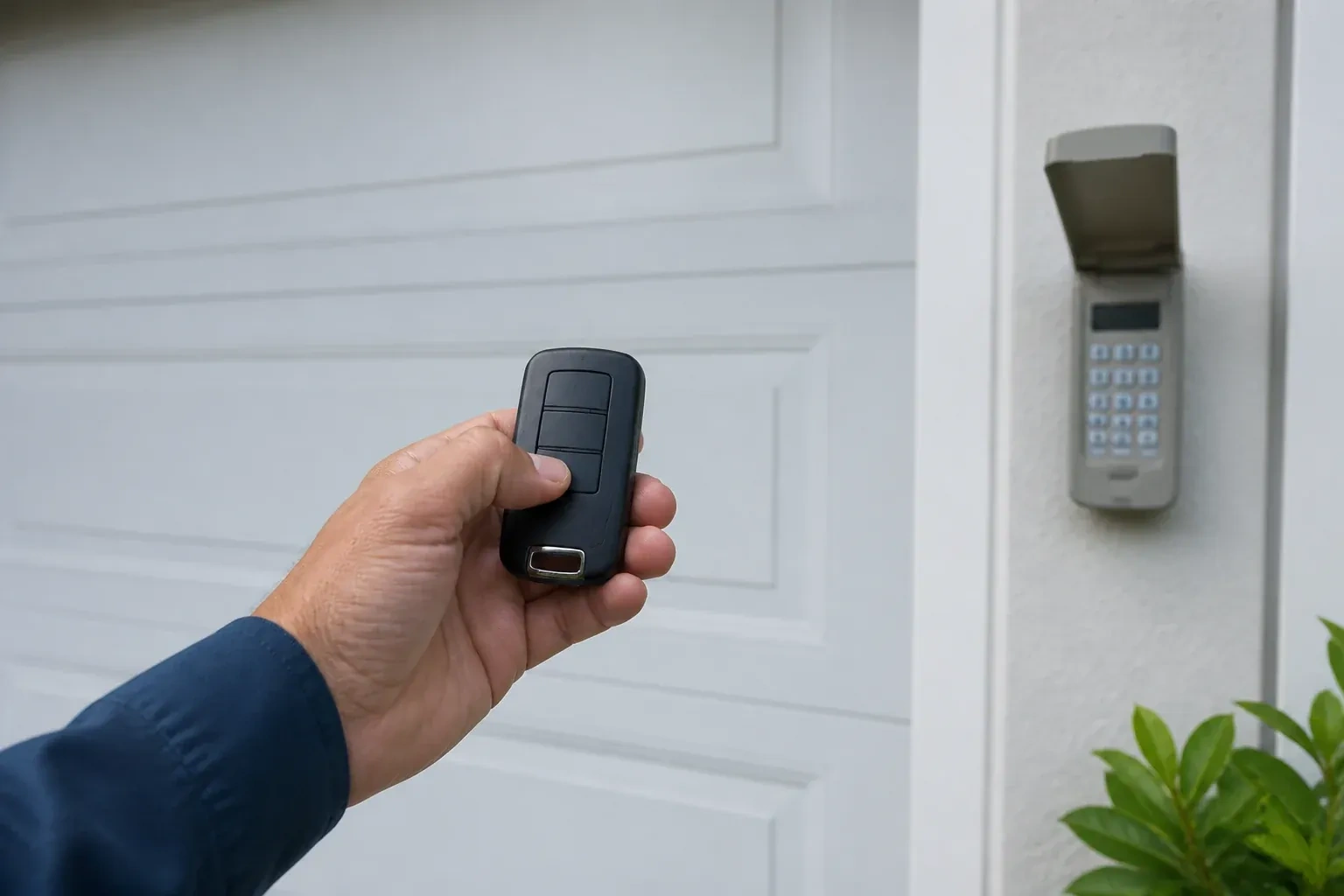
An outdoor wireless keypad lets the household in without a remote, and programming it properly is more than typing a code. The technician pairs it to the opener, sets a personal code you choose, and on many models adds temporary codes that expire after a set number of hours or openings, handy for a cleaner or a delivery. The keypad is programmed before it is screwed to the wall, fitted with fresh batteries suited to a cold climate, and mounted where a child cannot reach it and the door is in view. Codes stay private; they are not written on the paperwork.
How the visit goesSomeone in the family tried to add a remote, held the button on the ceiling unit a little too long, and now every remote in the house is dead at once. The wall control still moves the door. The remotes act as if they were never programmed.
Garage Door Remote and Keypad Programming
How the visit goes
Is the opener itself ready?
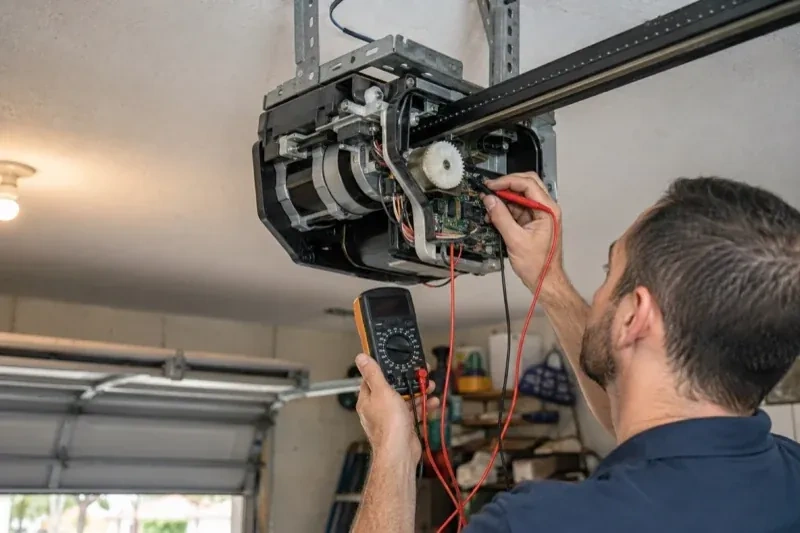
Programming only takes when the opener is in a state to accept it, so the first minutes are spent on the unit rather than the remote. The technician confirms the head unit has power and responds to the wall control, checks that the lock indicator is not blinking, and looks at the photo-eye lights near the floor to see the beam is aligned. The door is run through a cycle to be sure it travels and reverses properly. If the wall button moves the door and the remotes do not, the fault is on the wireless side and programming is likely to help; if nothing moves the door, the visit becomes a repair first.
Training the buttons in the car
A vehicle's built-in garage button often learns in two stages on rolling-code openers. First the car learns the remote: with the handheld remote carrying a fresh cell held close to the mirror or console, the vehicle button and the remote button are pressed together until the indicator changes. Second, the opener learns the car: the technician presses the head unit's learn button and returns to the vehicle inside the window that follows to press the trained button until the door moves. Some vehicle systems follow a different sequence with no handheld remote, so the vehicle and opener instructions are checked first. Where an older in-car system cannot hear a newer opener, a small bridge module is added.
Every control tested in your hand
Before the technician leaves you operate each device yourself: the remote from each car, the keypad with your new code, the vehicle button from the driver's seat, the wall control. You see the door open fully and close to a gentle seal from each one. If a remote has two or three buttons, you know which door or gate each drives, and a small label says so. You also watch the reversal tests performed, so you know the door backs off an obstruction and stops for the sensor beam. Nothing is left as something to try later on your own.
Garage Door Remote and Keypad Programming
In the van
Universal multi-generation remote
Add-on rolling-code receiver kit
Keypad mounting screws and anchors
In-vehicle compatibility bridge module
CR2032 and CR2016 coin cells

Garage Door Remote and Keypad Programming
What affects the quote
Receiver or logic board fault found
If a known-good remote also fails, the receiver or board is the cause; its diagnosis and replacement are quoted separately from programming.
Batteries supplied
Coin cells for remotes and the small cells in keypads are counted per device when the technician supplies them, and noted so you know what to buy next time.
Distance to your door
Travel is part of the visit, and a house across town and a property well outside it involve different driving time.
What to have ready
- What colour is the small learn or program button under the opener's light cover?
- Is the light on the wall control blinking steadily?
- Is any remote missing or stolen, or with someone who should no longer have access?
Garage Door Remote and Keypad Programming: questions
QuestionsWhat is rolling code and why does it matter for programming?
Most openers made from the mid-1990s on change their code every time a remote is pressed, choosing from billions of possibilities, so a copied code is usually useless next time; the technician confirms the actual system from the model, not age. Programming matters because the opener has to learn each remote's sequence at the learn button; a remote cannot simply be set to match. Older fixed-code openers, set by small switches, can be upgraded with an add-on rolling-code receiver.
Will unplugging the opener reset the remotes?
No. The stored controls survive a power cut or a long unplugging; the opener remembers them when power returns, and manufacturers say this plainly. Removing a control is done at the learn button, following the model's sequence, either by erasing the whole memory or, on some models, by deleting a single device through a supported wall control or app. That is reassuring after an outage and important after a lost remote.
My remote was stolen from my car. What should I do?
Have the opener's memory erased and your remaining controls reprogrammed, and do it soon, because a remote taken with a registration slip is a remote paired with an address. Erasing follows your opener's own sequence at the learn button, whatever that model requires; reprogramming your other remotes, the keypad and any vehicle buttons takes a few minutes more. Until then, the wall control's lock mode blocks all remotes as a stopgap.
Related services
- Chain-Drive Opener RepairPress the button and the opener hums for a second, then quits.
- Belt-Drive Opener RepairPress the remote and the motor runs its full cycle, lights on, the usual whir, but the door does not move a centimetre.
- Garage Door Opener ReplacementPress the button and the motor hums, but the door stays exactly where it is.